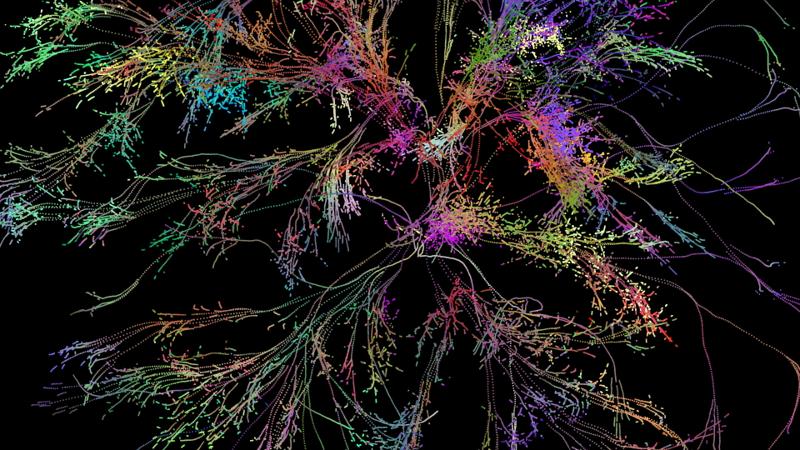
Dan Tapper is a digital magician, artist, and educator whose practice is built on a single question: what happens when simple rules collide. His work renders data into design, translating the invisible logic of the natural world into algorithmic beauty.
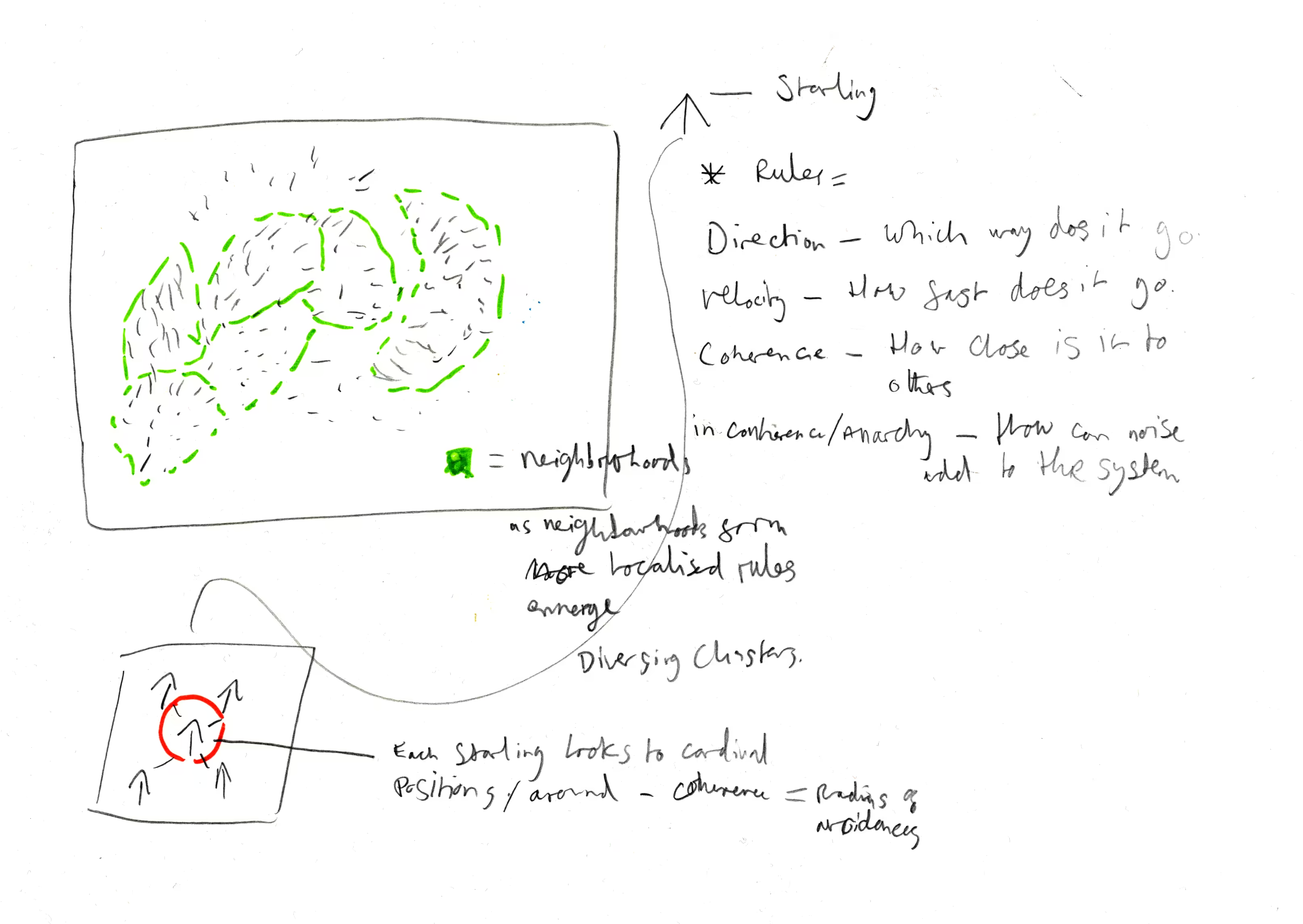
Before the interview, I gave Dan Tapper a blank piece of cardstock and some markers. Under a five minute timer, he was challenged to sketch an outline for an emergent process.
Talk me through your drawing.
There’s this thing in nature called a murmuration where lots and lots of starlings will flock and create these emergent patterns. Basically, there are some simple rules for how they decide to congregate. If we were trying to simulate this, every starling has a direction, it’s facing a certain way, it’s avoiding starlings around it. The goal is to fly within a flock and to avoid crashing into something else.
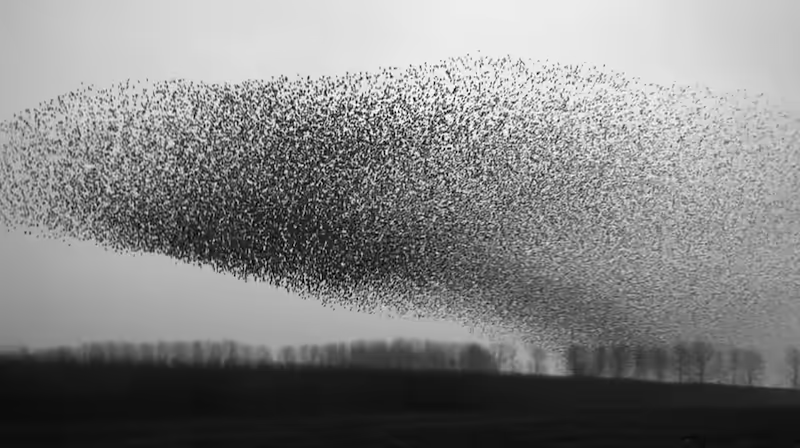
On the surface, that’s really simple, right? The idea of flying, no crashing. But there’s all this complicated stuff the starlings are doing, such as sensing where things are, adjusting their speed and their velocity all the time, so they don’t actually hit something else.
I find it interesting how all these interlocking parts become part of this greater collective consciousness, kind of like a symbiotic organism.
These little dots, are they alive?
Yeah, I think so.
For all of these individual little dots, I prefer to call them agents. Each agent has exactly the same set of rules, they can rudimentarily sense the environment and their closest neighbors and this avoidance and cohesion results in something dynamic and complex.
I don’t have the ability to go deep into nature and do field studies, but I can simulate to the best of my abilities these simple emergent networks, and then I can view them. You’ve set the rules, you’ve set the boundaries of a little sandbox environment, but then all these things happen that you’re not expecting that’s really cool.
Explain to me like I’m five: What is emergence?
Essentially, I think about emergence in terms of rules that are very simple on an individual level, but become complex at large scales. Murmurations are a great example of this, individually the starlings’ movements aren’t particularly exciting but en masse they become something larger than the sum of their parts. When I’m designing these systems I often use something called Object Oriented Programming. An object lets me define all the actions that an agent can take - e.g avoid neighbours, constrain to a certain area of space and these actions are then replicated for every agent created in the system. I can add variance to these actions so some agents might be more inclined to flock vs others.
I think about these systems as cookie cutters. If we think about a cat there’s all sorts of constants that we can define as cat. There’s colour, size, fluffiness factor. You can go as far as you like defining this. Changing parameters within your cat cookie cutter will create different variants of cat but they will all be a cat.
Dan’s collection of abstract works inspired by the movement of sandcrabs, designing branching patterns through the emergent consequences of agents carving into space under simple rules.
What exactly is the phenomena emerging from your simulations?
Ultimately, it does become an aesthetic thing. Once I’ve got something that is performing in an organic enough way, then I’ll highlight parameters that are going to create different results, and I just start experimenting with numbers.
For me, I kind of think of it more like a game. I want to make the coolest and most complex visual I can out of this set of parameters, so the challenge becomes: how can I do that?
What was the main decision that set you on the path towards a career in teaching interactive design?
I think it was just a confluence of chance, really. I taught workshops for a long time, but didn’t feel very confident teaching for ages. During COVID I started teaching more formally as a Professor, it was all very online. I would watch back lecture videos and I’d think, okay, I don’t like that, I’m speaking too fast, I’m not enunciating, or I say um a lot. I started to think about it more as a game. Next class I can go and I can explain this better, or change my approach. Over time it became something I really enjoy, and now teaching is a big part of my practice.
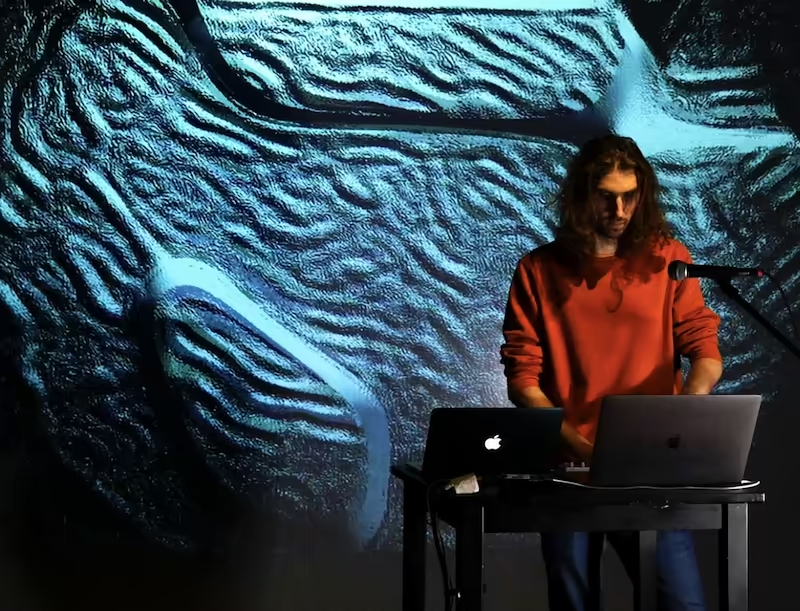
What itch are you scratching by falling into these eight-hour-long hyper-focus holes where you’re just playing around with these simulations?
I almost think it’s like a puzzle. I see a lot of art and I think it’s important to expand what you’re digesting. For example, I’ll read about a cool idea and think: oh that would be interesting to put into my system. I’ve always been much more interested in the science part. I love the visual, but I’m not at all precious about any of the things that I make.
Has making this work changed the way that you look at the natural world?
I did go through a lot of periods where I was seeing the work in day-to-day life. When I got into glitch art, I’d look up and see how pink the sky looked, and how it resembled a glitch. Seeing patterns everywhere, thinking it’s so emergent.
Corpsewalker, an art project as Dan describes: “moving through the graveyard of old musical ideas and making something new.”
And now, not really. I get more inspirations from art galleries nowadays. That way that artist’s shading or that kind of like pattern: how can I re-create that using the tools I know?
When you’re watching your own work come to life, editing the parameters and searching for interesting variations in your simulations, do you feel more like a naturalist observing or a god setting terms?
Neither, I just feel like a big nerd. I’m a big fan of this idea of tacit knowledge, which is just learning through doing. For me, it’s play.
“So fun to add in wonky forces and make spirograph patterns. Using the 0° pendulum crossing to trigger notes.”
Does human behaviour play a role in your simulations?
When I did my master’s in Fine Art, I worked with these concepts more. I was obsessed with Dadaism and Fluxus. I did a lot of stuff with thread, thinking about it as a trace of movement, and giving people different actions to do with the thread. It became a big mess, but that is something I’m interested in getting into again. Over the years, I’ve built a vocabulary of how to talk about this work and also have more experience public speaking, so I feel more equipped to engage with people and make a safe space for them to play.
I think it is really challenging because computationally these are all really simple agents, right? You know, theoretically you can script people to do stuff but it can be hard to communicate the system effectively.
Projector system demo built for Toronto’s Geary Art Crawl.
Lots of TouchDesigner projects use cameras or the Xbox Kinect to collect motion data. Are you interested in those types of integrations?
It’s really fun to add interactivity, and I do teach folks how to work with different sensors and live data feeds. I haven’t incorporated it into my own work so much, for me I’m particularly interested in seeing how systems evolve within a relatively limited environment. Adding in a lot of outside interaction looks cool but can make the types of processes I’m trying to reveal less impactful.
I’m currently trying to unplug a bit, taking the ideas I’m working with in computational systems and applying them or trying to find analogies in real world contexts. Working with people and performance is very interesting to me as well as getting involved at a micro level with biological processes. My father is a lichenologist so I’ve always been really fascinated by symbiotic organisms and their forms. Lichens are a nice bridge between the kind of computational art that I make and physical media, emergent forms that have also been used as dyes in traditional art for millennia.
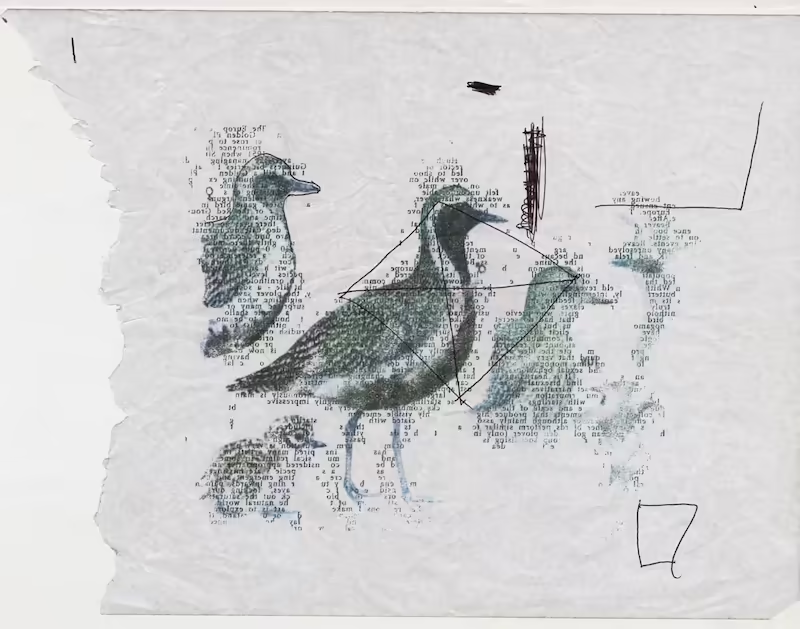
Dan’s experiments from the first year of his MFA, applying procedural processes and data translation into physical media.
“The idea becomes a machine that makes the art.” - Sol LeWitt
Emergence is often used as an argument for free will. The idea that consciousness is an emergent property that produces genuine agency. It is also used as an argument against free will, that what feels like a choice is just deterministic rules playing out at a higher level. Which direction does your work point towards?
That’s a great question. My work would definitely point towards the simulation side of that story. Sometimes it stresses me out, but I do definitely think, not in a woo-woo way, but sometimes you get those simulation-y kind of like coincidences that happen. I don’t necessarily believe in a simulated universe, but I can see why other people might.
As a final thought, how does the idea of translation inspire your work?
I think a lot about this idea of the narrative of data. Everything we interact with is tangible and we can quantify it in some way, and it’s shaped by our interpretations. Everyone’s experiencing the same stimuli, but interpreting it radically differently. Translation is figuring out what’s in between the source and the receiver.
Dan Tapper can be found on Instagram, and his creative programming tutorials are available on YouTube and Patreon.