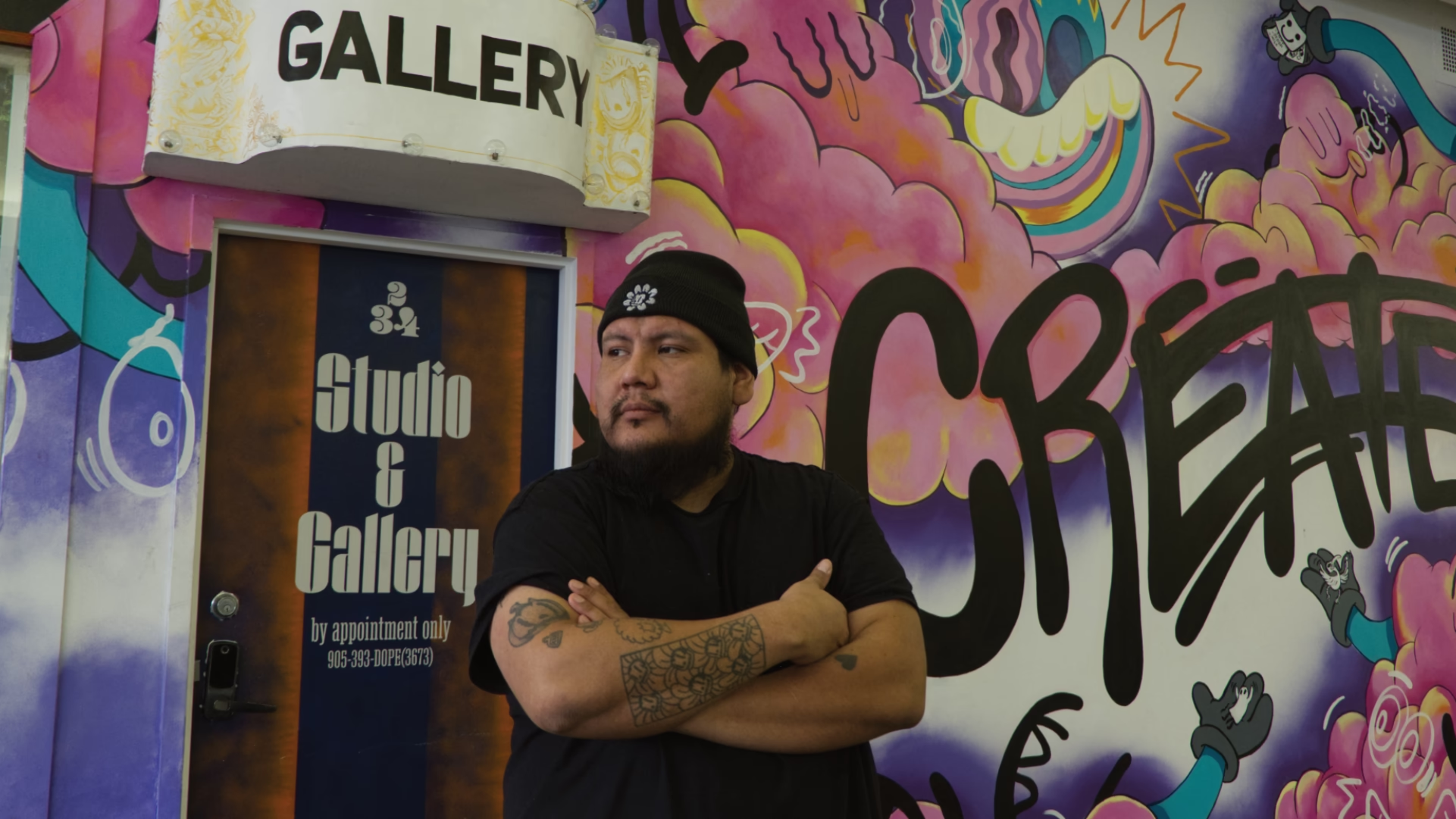
This creative wonderland hides in plain sight, nurturing local talent and hosting immersive galleries in a dying mall.
Dope Chief Studios operates inside Jackson Square, an under-loved mall located in Hamilton, Ontario. It sits between retail spaces and the food court, standing out like a psychedelic sore thumb with a fluorescent mural interrupting the otherwise desolate white hallways. Shoppers frequently gaze through the studio’s glass windows to peek at the super-sized sculptures, bright pink furniture, and paint-splattered f loors, curious to know more about this magical, imaginative space.
The head of the studio is Dope Chief himself, a local indigenous artist who grew up in Hamilton. His work traverses many mediums, going between murals, sculpture, fashion, and taking heavy influences from 90s and early 2000s pop culture.
Dope signed the studio’s lease 10 days before the COVID 19 pandemic started. He caught a lucky break when the VP of Jackson Square saw a CBC Hamilton article about his previous studio being demolished, and invited him to rent a multi-room unit inside the mall. This space was unappealing to typical retailers because of it’s low-traffic location and the need for repair & maintenance — the unit had been vacant for at least five years. It would be a bad investment for any retailer but it was absolutely perfect for an artist like Dope Chief and his artist collective.
Malls are slowly losing customers to online retailers, which is especially difficult in Hamilton, a city which will always be overshadowed by Toronto, a nearby municipality with ~5.2× the population. Across the world there have been examples of malls changing their business models by turning empty storefronts into apartments units, or other unconventional spaces, which is a necessary approach when real-estate is such a finite resource. In this case, artists like Dope Chief receive the opportunity to create in a large space for considerably lower rent. For Jackson Square this brings a small gaggle of creators into the mall’s milieu, ever so slightly pushing it into the future and beyond the era of online shopping. To work in this studio, artists pay with their motivation. Every season begins with a “Studio Cycle”, and members must undergo an application process where they identify creative goals and current projects. Only serious applicants who have the intentions their grow artistic careers are chosen. There’s no monetary cost for members, because creativity is the currency. To attain privileges of consistent studio access and a personal workspace, artists need to show up, actively pursue their creative projects, and contribute to the artistic atmosphere.
All members share the same goal: find creative success and produce radically interesting artwork. Here, everyone is always collaborating, giving feedback, and treating their art projects like assignments. The studio even uses a point system to track the artist’s progress each season, to ensure the ecosystem is always prioritizing dedicated members.
Last year, the studio hosted its first exhibition: Future History Today. Over a period of 4 months, artists collaborated in transforming the space into an immersive wonderland.
Each member was given their own corner of the unit, and had full freedom to change the space, taking advantage of the “anything goes” atmosphere. This pilot project was a test to see what the artists were capable of, and it went beyond expectations.
“I want to build Xavier’s school for the gifted, from X-Men”
Each station had a completely unique vision. Studio artist Baumchell built a mirrored altar where participants could gaze into their own reflection and use a magic pebble to make a wish. In another station, guests crawled through a doghouse sized entrance, which lead to James Favron’s secret clubhouse filled with Archie comics, a huge coloring book, and a retro Nintendo station. Anthony Giovannetti built an incredulously detailed miniature world inside a closet sized space. When artists have full creative control and a supportive community, they can create a once-in-a-lifetime exhibit.
Since the success of this pilot project, Dope Chief Studios has been planning their next show This year’s objective is to exhibit in a larger space, acquire public funding, and utilize their creative team to blow past their initial experiment and create an expanded art experience.
“Artists need somewhere to belong”
Community is a huge inspiration to Dope Chief’s creative practice because it offers a unique blend of resources and safety to develop unconventional ideas. Dope believes that informed feedback is underrated, offering the example of how an artist might not share their ideas with a friend or family member because the person lacks context and might not have the experience to understand what feedback the artist actually needs.
Dope reflects on Hamilton’s atmosphere, where the underbelly of society is impossible to ignore. Everyday, the artists witnesses addiction from people that have been abandoned by a broken system, something especially visible in the studio’s mall, which sits across the street from a Salvation Army shelter.
“You’ll get everything in the mall. You’ll get people doing meth in the mall. You’ll get people fighting. You’ll get people sleeping or just getting wasted.”
Dope explains that artists move into areas where rent is cheap because they are similarly undervalued by society. Hamilton’s unhoused population doesn’t drive investment, but when the economics of supply and demand create a hole in the market, it can become an opportunity for artists who can manage to coexist alongside those that upper class folk might find unseemly.
Art can be a brief escape from this bleak reality and potentially inspire a more hopeful future. Also located within the mall is the Hamilton Public Library’s Central Branch which includes a maker space with 3D printers, an embroidery machine, iMacs, and large format printers. Despite all odds, collectives such as Dope Chief Studios can find resources, and create these immersive exhibitions for locals to enjoy, perhaps even challenging them to imagine what the world would look like if human creativity was a priority. This is how ‘normal people’ are converted into artists. This is how we support radical change.