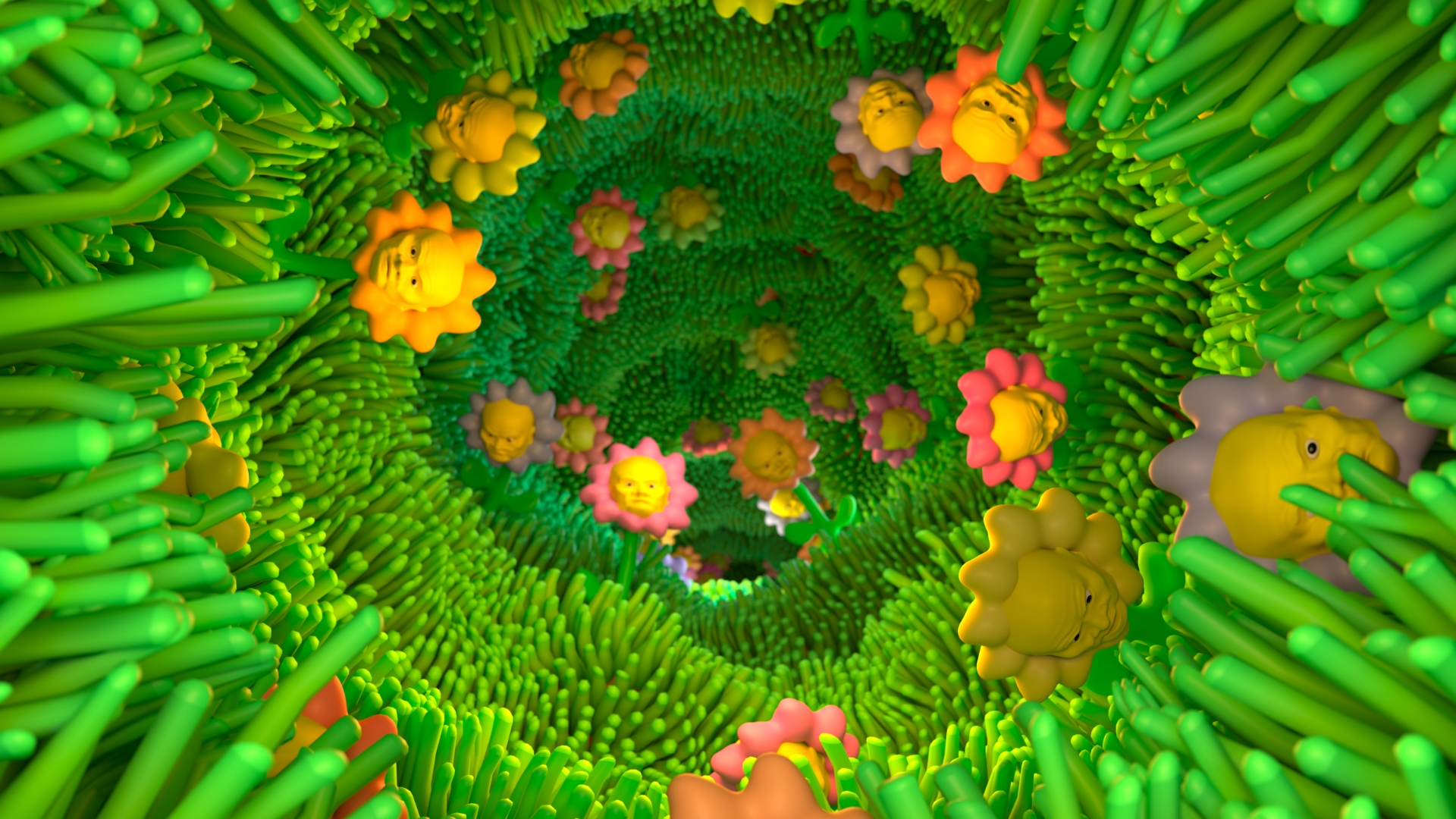
Yapping with the Animation Director of the 'Tall Grass' animated music video, by Creed Bratton (yes, Creed from the Office).
Matt Siegel is a 3D Generalist based in Los Angeles, California. He enjoys crafting whimsical, surreal, and magical worlds for freaky characters to inhabit and run around in.
He was the Animation Director for the music video Tall Grass by Creed Bratton, who is most known for his hilariously weird role in The Office. The project is a collaboration with studio Open The Portal, and is a combination of live action and 3D animation, resulting in a psychedelic journey through the different worlds inside of Creed Bratton.
What was it like making a music video for such a well-known figure?
Many people were going to be see the video, and I felt the responsibility to make it look great. But despite the pressure, it was also incredibly exciting, because I got to create some weird sh*t. That’s what Creed is down for.
How much did you plan the music video before diving into production?
A lot, I would say. I received some initial guidance from Open The Portal, because they had already produced live-action footage that my animation sequences would have to integrate with. They already knew that the camera was going to fly into his mouth, and transition into a surreal 3D world.
They also wanted to incorporate Creed’s weird interests. For example, Creed wanted fish to be in the video. He also enjoys robotic stuff, and is fascinated by the singularity, specifically about tech and AI from a spiritual standpoint. I believe that was the ethos of his entire album.
Before we started, I had a rough animatic and a good idea of how the animation was going to play out.
What was it like being able to pick your own team of artists and collaborate with them?
We had 6 people working on the animation production. I got to bring in talented friends, and give them creative freedom, whilst helping them get paid for a widely seen project. It was also a great lesson in leading a team and ensuring the project felt cohesive.
How difficult was it to capture his essence in a 3D model?
It was tough because I’m still new to VR sculpting. Usually I model in Houdini, where it’s procedural, and an indirect process, unlike sculpting in VR, where it’s more created by hand. There’s also going back and forth on 10 reference pictures of Creed, trying to sculpt him, and feeling “This looks kinda like him. But also why does it look nothing like him?”
I was studying his face and asking myself: “where do I need to put wrinkles? Is he gonna be upset if I put wrinkles?” I bugged a lot of people for feedback, and they helped me point out what needed to added or be dialed in.
What is VR Sculpting?
VR sculpting is a technique where you create 3D models whilst using a virtual reality headset. It’s incredibly cool, because I’m essentially making something out of nothing. It’s similar to holding a virtual can of graffiti, but instead of paint, it’s spraying clay into 3D space.
In Adobe Medium (VR Sculpting Software), your head and the camera are the same inputs, so you can reach around the model, and manipulate it by extending your arm, or add details by bringing your eyes up close to the surface. It truly feels like you’re inside the three-dimensional space.
With VR sculpting, it’s really hard to get something perfect, but I like how that adds a layer of personality to it. It’s super intuitive.
Were there any unexpected surprises during your creative process?
Initially, we had this idea of featuring Creed going through all the stages of his life. We produced an animation with the baby version of Creed, running through the meadow. However, when we’d show other people the edited cuts, nobody understood who the little kid was. We even tried putting adult Creed’s head on the baby’s body, but that looked even weirder, so we realized that we needed to get rid of that part altogether.
We replaced it with some establishing shots, which gave more time to show off the art. Turns out taking out complexity made the work shine.
Did you ever have a “this is either genius or a huge mistake” moment whilst making this?
I still feel imposter syndrome sometimes, and I can get stressed when I’m sending work in. There were many moments I’ve freaked out and asked myself: “Why did I ever think this is a good idea?”
My girlfriend, Anca, as well as my friends, would all reassure me that the project looked amazing. But there’s always this question at the back of my mind: “Is anyone gonna relate?”. But I believe that’s just anxiety about showing a big personal project to a large audience, and not knowing how they’ll react.
What’s a small detail in the video that you’re really proud of?
There’s a scene where the robot baby flies up and grabs the camera, doing a dramatic leaning back in anticipation, then shoving the camera into the distance. I’m really proud of this shot because it mainly consisted of meticulously placed keyframe animation. I had to slow down all the movement, and adjust each frame to ensure it looked like the robot was actually holding the camera. It was a ton of work, but it was also one of my favorite pieces of animation that I’ve ever done.
Why did you choose Houdini to animate your quirky and unconventional style?
I have a background in computer science, so when I dove into 3D, Houdini made the most sense to my mind because it was logic-based and artist friendly at the same time.
oudini opened the doors to me creating insane simulations and floppy procedural characters. It’s easy to add rotational noise to all parts of a rig, and have it feel like it’s breathing, making it easy to animate dynamically weird characters in that software
What’s the weirdest technical problem you ran into during the project, and how did you fix it?
I have a reusable rig tool that I’ve built, where I can attach a pre-built skeleton on a character, and start animating with it immediately. I used it for all the characters in the video. But for mysterious and horrible reasons, the leg puppeting system just wasn’t working. I’m positive that everything was set up correctly, including the twist joints, but as soon as I started moving the legs, the knees would point in the wrong direction.
My solution was to avoid animating the legs. Technically, I didn’t solve it at all, but I also didn’t have the time to. I had to ask myself, how can I animate this scene without using the legs? The answer was to make all the characters float/fly, without using any walking whatsoever. Sometimes I’d have the knees bend a little, but if I pushed it too hard, they would get f*cked up.
There was a scene where Creed was flying through a canal, and I wanted him to roll around in a dramatically cartoonish fashion. However, I couldn’t get it to work, so I just animated him f lying in a basic way. This problem forced me to simplify, which was a blessing in disguise. Being a perfectionist, I often spend too much time on details that don’t matter.
Looking back on the whole process, what’s the biggest lesson that you learned?
Just keep it simple. You can always add a little f lourish after you’ve gotten the main points across. Some shots are on screen for a second and a half, and a person would would have to watch the animation 30 times before they pick up on that small detail you spent hours on.
What’s next for you? Any exciting projects on the horizon?
I’m working full-time at FX on Alien Earth, focusing on rigging. For personal projects, I’m finishing a short film with Jared Corwin and Cartuna, as well as producing a new short for Hellavision with my girlfriend Anca and friend Kael. Definitely applying the lessons I’ve learned from the Tall Grass music video on these new projects.
What do you think is the future of creativity?
AI is changing the creative industry, raising questions about whether it will replace parts of the process or entire artistic roles. While it may make production more accessible and efficient, I worry it could diminish appreciation for handson creativity. Some artists love every step of the process, and automation risks taking that away. Despite job concerns, AI could also open new opportunities for independent creators. I just hope we don’t lose the beauty of the creative process.